Researchers at the Helmholtz-Zentrum Dresden-Rossendorf (HZDR) have made a groundbreaking discovery involving new oscillation states in magnetic vortices, termed Floquet states. This finding, published on January 8, 2026, in the journal Science, reveals that these states can be generated using minimal energy, specifically through magnetic wave excitation rather than the previously required high-energy laser pulses.
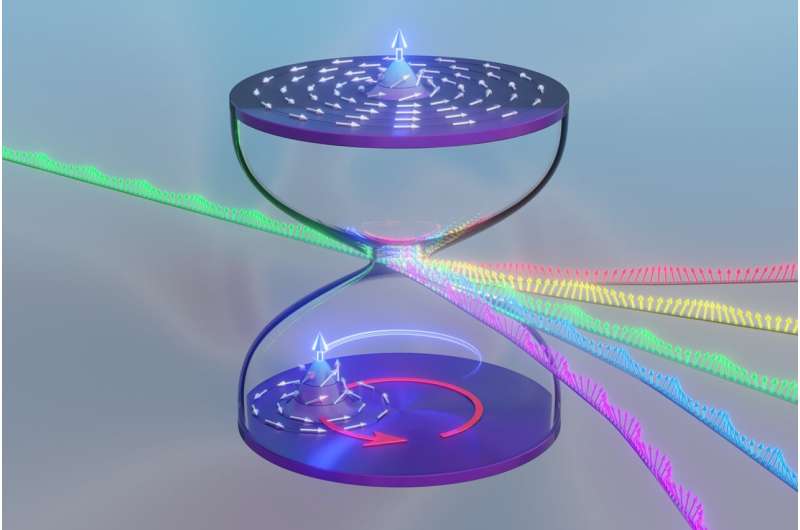
Magnetic vortices can emerge in ultrathin disks of magnetic materials, including nickel–iron. Within these vortices, the magnetic moments align in circular patterns. When disturbed, waves propagate through the system similar to a wave in a stadium, allowing each magnetic moment to transfer its impulse to the next. This phenomenon, known as magnons, enables information transmission through magnetic materials without the need for charge transport. Dr. Helmut Schultheiß, project leader at HZDR, highlights the significance of this capability for future computing technologies.
The research team focused on disks with diameters reduced to a few hundred nanometers, aiming to explore their potential for neuromorphic computing. During their analysis, they were surprised to find an entire series of finely split resonance lines—an unexpected frequency comb. Initially, the researchers believed this was a measurement error. However, upon repeating the experiment, they confirmed the existence of these new states.
The concept behind Floquet states was introduced by Gaston Floquet in the late 19th century, demonstrating that systems subjected to periodic driving could develop new states. Traditionally, creating such states demanded intense energy inputs. The HZDR team discovered that in magnetic vortices, strong excitation of magnons could induce these states by causing the vortex core to perform minute circular motions. This slight movement results in a rhythmic modulation of the magnetic state, manifesting as a frequency comb.
What sets this discovery apart is its energy efficiency. Unlike systems requiring powerful laser pulses, the process can be initiated with inputs as low as microwatts—similar to the energy a smartphone consumes while on standby. This low-energy requirement opens new avenues for linking disparate systems, potentially synchronizing ultrafast terahertz phenomena with conventional electronics and quantum components.
Dr. Schultheiß refers to this capability as a “universal adapter.” Just as a USB adapter connects devices with different connectors, these Floquet magnons may bridge frequencies that would otherwise remain incompatible. Looking forward, the research team plans to investigate whether this principle can be applied to other magnetic structures.
The implications of this discovery are significant. It not only addresses fundamental questions in magnetism but also presents opportunities to develop new computing architectures that facilitate interaction between magnonic signals, electronic circuits, and quantum systems. Dr. Schultheiß emphasizes that this research could eventually serve as a valuable tool for connecting the realms of electronics, spintronics, and quantum information technology.
For further details, the full study is available in the journal Science: Christopher Heins et al, “Self-induced Floquet magnons in magnetic vortices,” DOI: 10.1126/science.adq9891.