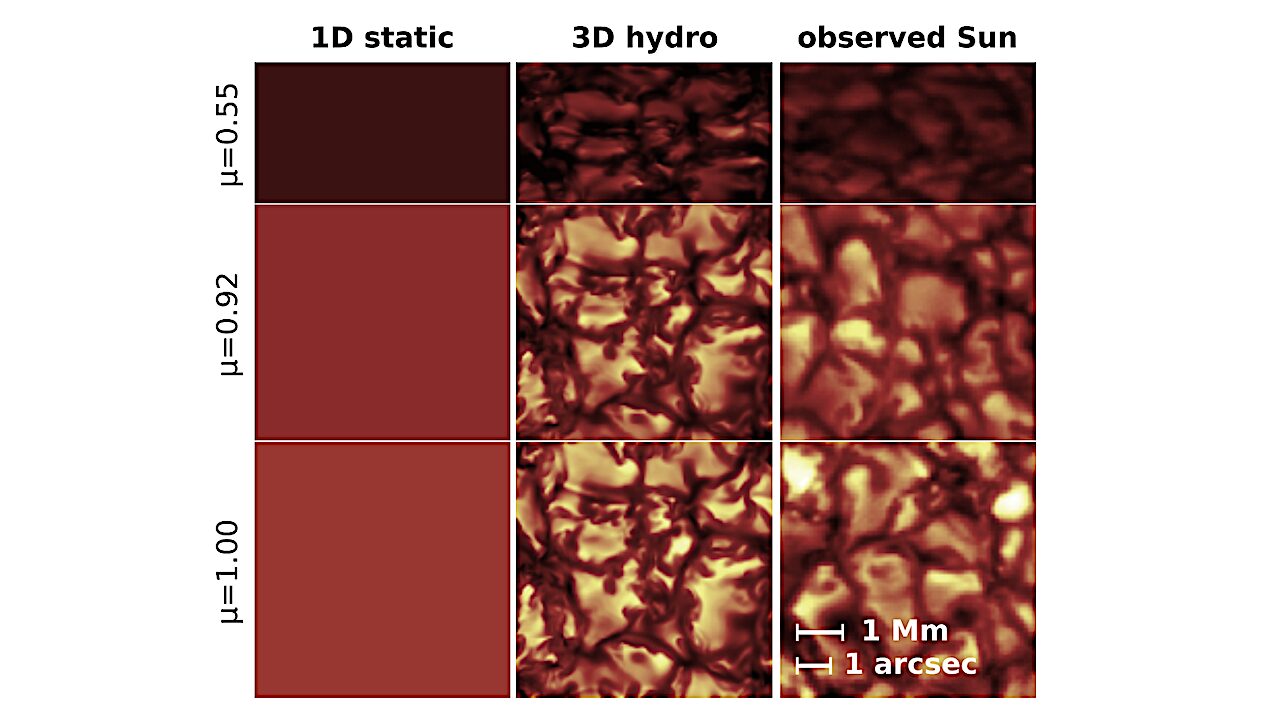
Recent research has significantly advanced the understanding of carbon abundance in the Sun by employing innovative 3D Non-LTE (NLTE) modelling techniques. This work, conducted by a team of scientists including Richard Hoppe and Maria Bergemann, aims to provide a more accurate measurement of solar carbon levels using the spectral lines of the CH molecule, a vital indicator of carbon presence in FGKM-type stars.
Traditionally, the analysis of CH lines has been limited to 1D LTE models, which have proven inadequate for capturing the complexities of line formation in solar spectra. In this study, the researchers utilized updated NLTE models as described by Popa et al. (2023) to assess the formation of CH lines across various solar 3D radiation-hydrodynamics model atmospheres. The results indicate that 1D models consistently underestimate solar carbon abundances due to their simplistic approach.
Findings and Implications for Solar Carbon Measurement
The research employed spatially-resolved optical solar spectra to measure the center-to-limb variation (CLV) of CH lines, leading to a new estimate of the solar photospheric carbon abundance at A(C) = 8.52 ± 0.07 dex. This figure aligns with recent data derived from neutrino flux measurements conducted by the Borexino experiment, which further validates the findings.
The implications of these findings extend beyond just the analysis of carbon in the Sun. The study highlights the importance of 3D NLTE modelling in accurately determining elemental abundances across a range of astrophysical contexts. The researchers anticipate that similar results may apply to other molecules of interest, enhancing the broader understanding of stellar atmospheres and compositions.
Conclusion and Future Directions
The comprehensive analysis presented in this study underscores the necessity of advanced modelling techniques for deriving reliable solar abundances. By moving beyond traditional methods, the research lays a foundation for future investigations into the chemical compositions of stars, paving the way for a deeper understanding of stellar processes and evolution.
The full study has been accepted by the Monthly Notices of the Royal Astronomical Society and spans 22 pages, available for reference at arXiv:2511.14289. This work not only enriches the field of solar and stellar astrophysics but also encourages further exploration of complex molecular diagnostics in the cosmos.