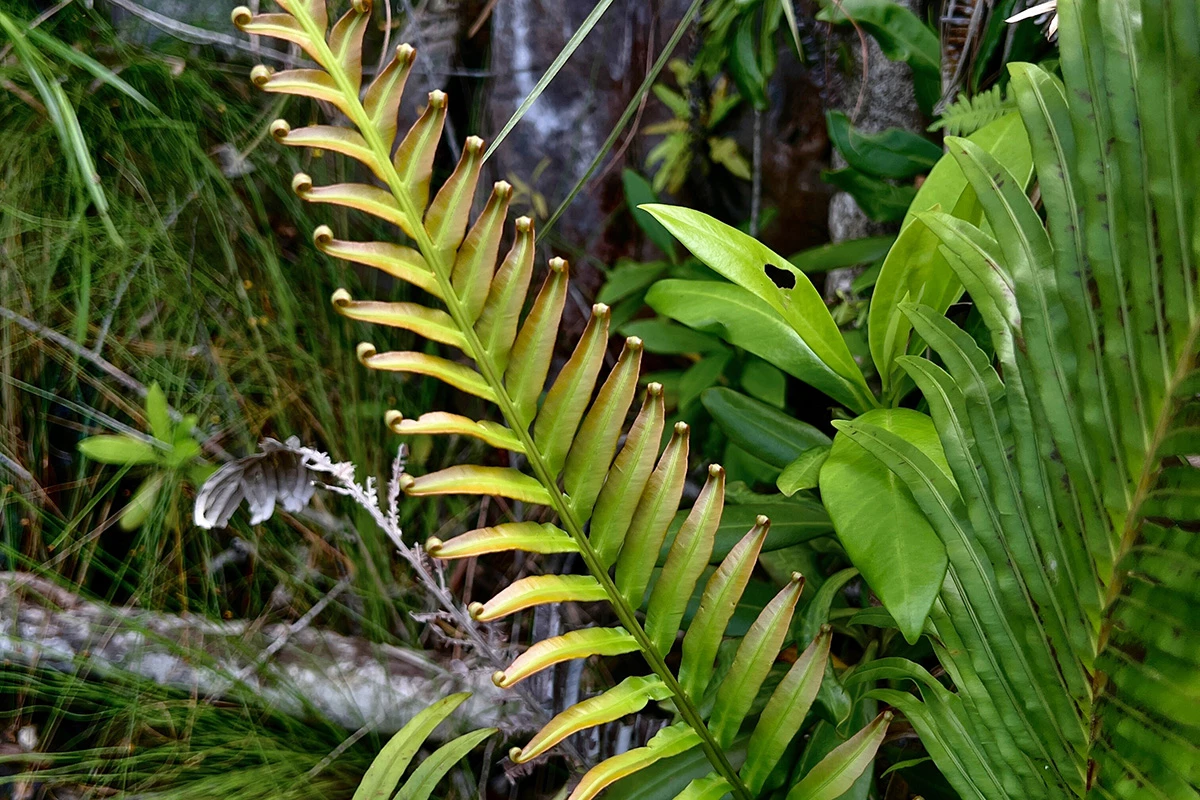
A team of scientists in China has made a groundbreaking discovery: a common fern, known as Blechnum orientale, can naturally extract rare earth elements (REE) from the soil. This finding, detailed in a study published in the journal Environmental Science & Technology earlier this month, could revolutionize how these essential materials are sourced for technology production, ranging from electric vehicles to smartphones.
Rare earth elements are critical for various high-tech applications, yet traditional mining practices often lead to significant environmental damage. The research, led by geochemist Liuqing He from the Chinese Academy of Sciences, reveals that this fern can crystallize REE minerals within its tissues under ordinary conditions, eliminating the need for destructive mining techniques.
Understanding the Discovery
Typically, REEs are found in low concentrations within specific igneous rocks, forming only after magma cools. In stark contrast, Blechnum orientale acts as a hyperaccumulator plant, thriving in soil with high levels of heavy metals that would be toxic to most other species. This fern absorbs these metals through its roots, facilitating a unique form of mineralization.
He explained the significance of this finding, stating, “This fern can facilitate REE mineralization, specifically producing the mineral monazite, which was previously known only to occur in rocks subjected to extreme conditions deep within the Earth.” The ability of this fern to produce nanosized monazite particles under normal surface conditions is a striking deviation from established geological processes.
Implications for Future Resource Management
The discovery opens the door to a potentially transformative technique known as phytomining, which utilizes hyperaccumulator plants to extract metals from soil. This could significantly reduce the environmental impact associated with traditional REE extraction methods, which often result in topsoil degradation, vegetation loss, and pollution of local water sources.
Currently, China dominates the global REE supply chain, controlling approximately 70% of worldwide rare earth mining and an even greater share of processing capacity. As demand for these minerals grows, especially in electric vehicles where elements like neodymium, dysprosium, and praseodymium are essential for powerful magnets, the need for sustainable and efficient extraction methods becomes increasingly urgent.
While Blechnum orientale has not yet been shown to produce REEs in large quantities, the research indicates that further exploration into the potential of phytomining is warranted. Researchers aim to determine whether this fern is unique in its ability to self-organize REEs from various elements or if other plant species can perform similar functions.
Moreover, the team is looking to develop effective methods for extracting monazite and processing it into its component REEs, ensuring minimal loss of this valuable resource. “This discovery reveals an alternative pathway for monazite mineralization under remarkably mild conditions and highlights the unique role of plants in initiating such processes,” the researchers commented.
This innovative approach to sourcing rare earth elements could address ongoing challenges faced by countries worldwide in securing a stable supply of these critical resources. As research continues, the potential for plants like Blechnum orientale to change the landscape of REE extraction remains an exciting frontier in both environmental science and resource management.