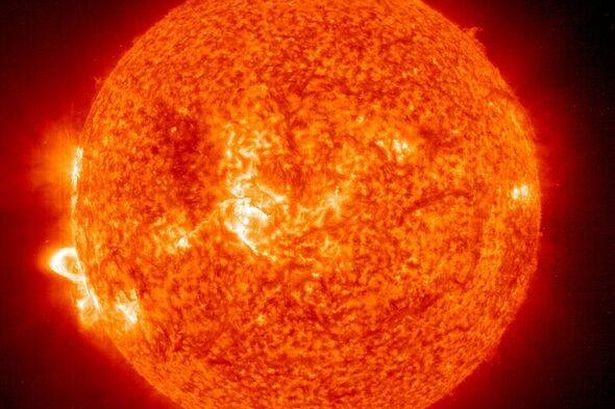
A significant sunspot cluster, known as AR 4294-4296, has rotated into view on the sun’s Earth-facing side, drawing attention due to its size and potential impact. While this formation resembles the one associated with the historic Carrington Event of 1859, scientists emphasize that the likelihood of a similar catastrophic solar storm occurring is quite low.
The sunspot group, which became visible on November 28, consists of two linked formations, AR 4294 and AR 4296. Interestingly, NASA’s Perseverance Mars rover detected these dark regions a week prior, as it monitored the sun’s far side. The current sunspot cluster is noted to be approximately 90% the size of the Carrington Event sunspot, which produced the most powerful solar storm documented in history.
Sunspots can emit solar flares, which are bursts of radiation resulting from the twisting and breaking of magnetic field lines. These bursts can lead to temporary radio blackouts and contribute to coronal mass ejections (CMEs) that impact Earth’s magnetic field and disrupt electronics. Spaceweather.com describes AR 4294-4296 as “one of the biggest sunspot groups of the past 10 years,” with the potential to unleash X-class flares, the most intense category recognized by the National Oceanic and Atmospheric Administration.
The original Carrington Event produced an X45 solar flare, a magnitude not observed since then. Geological evidence suggests even more powerful solar flares may have occurred prior to human existence. To illustrate the scale, an X45 flare outmatches the strongest solar flare noted in the past decade, which reached an X7 level in October 2024. Researchers warn that if a flare of such magnitude were to strike Earth today, it could devastate satellites and disrupt the electrical grid, potentially resulting in damages exceeding $1 trillion.
Despite the alarming size of AR 4294-4296, experts caution that size alone does not guarantee a massive solar storm. The configuration of the sunspot’s magnetic fields and the frequency of their eruptions are critical factors in assessing their explosive potential. Some larger sunspots may not produce significant solar activity at all. The magnetic fields of AR 4294-4296 are interconnected, suggesting that solar flares are possible, and the group has already emitted a potential X-class flare while on the sun’s far side.
While the current sunspot cluster is being closely monitored for any signs of activity, scientists believe that the chances of a storm on the scale of the Carrington Event are minimal. Observations of the magnetic fields will continue, providing insights into any forthcoming activity. If AR 4294-4296 moves past Earth without significant eruptions, the structure may remain intact, indicating the possibility of a return encounter around Christmas.
As the sunspot cluster points directly at Earth, researchers encourage calm. Although the public may experience auroras and minor technological disruptions in the coming week, the potential for a repeat of the Carrington Event remains exceedingly low. Ongoing vigilance will help ensure preparedness for any solar activity that might occur.