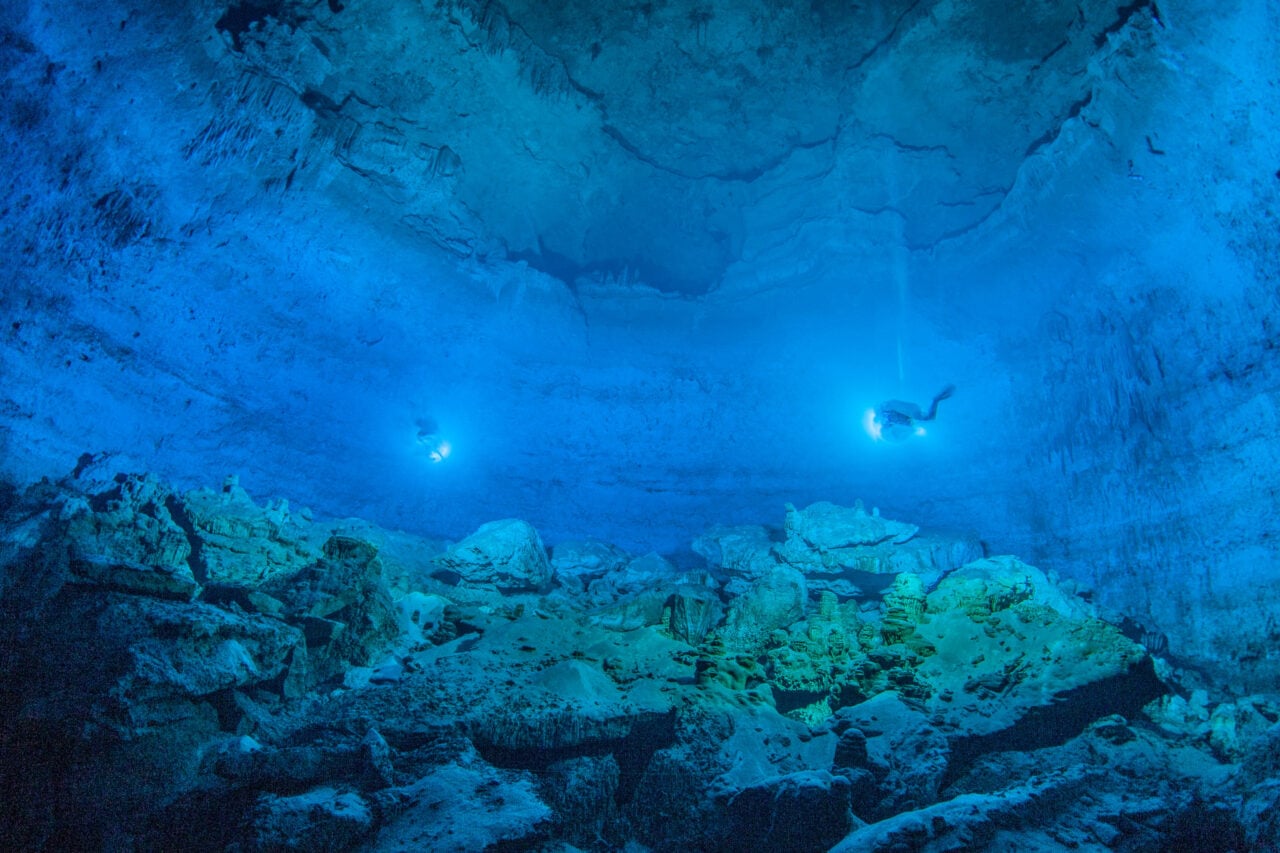
Deep beneath the lush forests of the Yucatán Peninsula lies a remarkable underwater cave system that has remained largely unexplored for millennia. Known as Hoyo Negro, or “Black Hole,” this submerged pit is part of Sac Actun, the second largest cave system in the Mexican state of Quintana Roo. Significant discoveries in these depths, including ancient fossils and human remains, have provided a rare glimpse into a world that existed during the Late Pleistocene, around 126,000 to 11,700 years ago.
In 2007, divers Alejandro Alvarez, Franco Attolini, and Alberto Nava Blank discovered Hoyo Negro, leading to the establishment of the Hoyo Negro Underwater Archaeological Project by the Instituto Nacional de Antropología e Historia (INAH). The project, which began in 2010, comprises an international team of paleontologists, archaeologists, and divers from Mexico, Canada, and the United States, dedicated to uncovering the secrets hidden beneath the water.
The Exploration Challenge
Roberto Chávez Arce, a co-director of the project, has been diving into these tunnels since 2011. He describes the initial exploration as perilous due to the uncharted and dark nature of the cave system. Divers must carry extensive safety equipment, including breathing gear, navigation lines, and lights, while also documenting their findings with cameras. “We need redundant gear in case anything fails,” Chávez Arce emphasized, highlighting the risks involved in such exploration.
Accessing Hoyo Negro presented its own challenges. Initially, divers entered from a cenote located 3,000 feet from the pit, taking nearly an hour to swim there. Today, thanks to the discovery of a closer cenote 250 to 300 feet away and the use of motorized scooters, the journey is significantly more efficient.
In the early stages of mapping the cave, the team relied on basic tools like compasses and tape measures. They have since advanced to using structure-from-motion (SfM) photogrammetry, which involves overlapping images to create a detailed 3D model of Hoyo Negro and its surroundings. This virtual representation has proven invaluable for researchers unable to dive into the depths themselves.
Fossil Discoveries and Human Traces
The discoveries within Hoyo Negro are as fascinating as they are varied. Fossil remains, including those of the ancient human skeleton known as Naia, have shed light on the lives and environments of the people and animals that once inhabited these caves. Naia, discovered in 2007, is estimated to have lived around 12,970 to 12,770 years ago. She is considered one of the oldest and most complete human skeletons found in the Americas.
Dr. James Chatters, another co-director of the project, detailed Naia’s tragic fate. The analysis of her bones indicates that she was likely between 15 to 17 years old at the time of her death, having suffered a broken pelvis from a fall. “She landed right on her pubic bone,” Chatters noted, emphasizing the dangers of the pit.
Beyond human remains, the cave has revealed numerous animal fossils, including extinct species such as the short-faced bear (Arctotherium wingei) and the ground sloth. The presence of these animals indicates that the cave system served as a vital water source in a landscape that was once a savanna, attracting various species.
The study of sediment cores and ancient deposits has revealed that the water level in Hoyo Negro fluctuated over time. Evidence suggests that water reached the bottom of the pit at least 9,850 years ago, eventually leading to the flooding of the entire cave system approximately 6,000 years ago. This timeline provides critical insights into when human and animal access to the cave was possible.
In addition to fossil remains, traces of human activity have been discovered, including mining for ochre—a mineral used in various cultural practices. Evidence of fire use within the caves further suggests that ancient inhabitants utilized the underground environment for practical purposes.
As the project continues, researchers remain intrigued by the unanswered questions surrounding the lives of those who ventured into Hoyo Negro. Whether they were seeking resources, hunting, or seeking refuge remains a topic of ongoing investigation.
The work at Hoyo Negro and the broader Sac Actun cave system illustrates the significance of these underwater landscapes for understanding the history of life in the Americas. With each dive, researchers uncover more about the complex interactions between humans and their environments during a pivotal era in our planet’s history.
As exploration continues, the findings from Hoyo Negro promise to deepen our understanding of the ancient ecosystems and the evolution of species, both extinct and extant, providing a fascinating window into the past.