High school sophomore Abigail Merchant has developed a groundbreaking solution to combat flooding, a growing concern exacerbated by climate change. The 15-year-old from Orlando, Florida, has created a flood-detecting CubeSat, a small satellite designed to enhance emergency response efforts during natural disasters. Flooding is a significant risk in her state, where low elevation and increased rainfall due to warmer air intensify the threat.
Flood response typically relies on conventional satellites, synthetic aperture radar, and GPS technology. However, these systems often suffer from technological failures and slow data transmission, leading to delays in emergency responses, according to the U.S. Environmental Protection Agency. Merchant recognized the urgency for more reliable methods and, last year, built a more efficient tracking device—a standardized CubeSat integrated with artificial intelligence (AI).
Innovation in Disaster Response
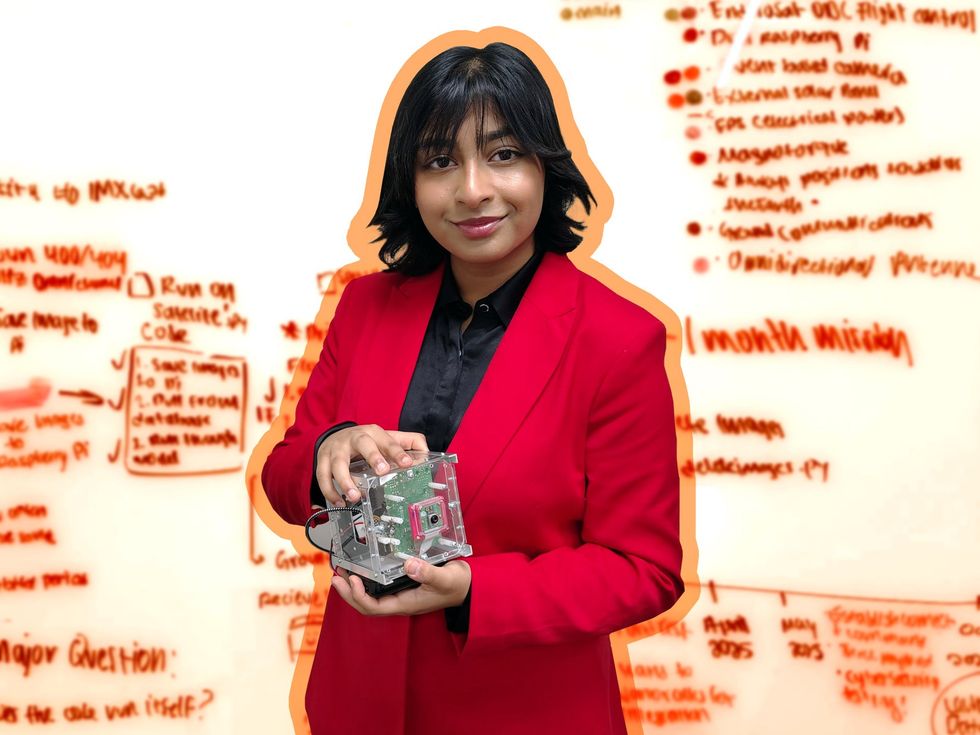
Merchant’s CubeSat measures 10 by 10 by 10 centimeters and uses off-the-shelf components for its solar panels, batteries, and computers. The satellite captures high-resolution images of areas at risk of flooding and employs pattern recognition to assess infrastructure damage and track survivors. This device is lightweight, weighing only about 495 grams, and cost approximately $310 to produce.
She showcased her research at the IEEE SoutheastCon, stating, “
IEEE is a foundational part of my growth as a young researcher. It turned engineering from my dream to reality.”
Her interest in disaster response ignited after learning that emergency workers can wait several hours for satellite data. Determined to improve this, she explored the capabilities of CubeSats, which can form constellations to deliver near-real-time data.
Merchant and her team, known as the Satellite Sentinels, participated in the MIT Beaver Works Build a CubeSat Challenge. Their CubeSat, powered by a convolutional neural network (CNN), can identify severely impacted flood zones and collect critical data for disaster relief. Merchant played a vital role as the payload programmer, leading the design and simulation of the mission, which included hardware planning and developing autonomous software.
Advancing Technology for Better Outcomes
During the challenge, the team created a 3D model of their CubeSat to refine its design. They utilized a Raspberry Pi, various sensors, and a camera, all encased in a transparent cube. The CubeSat is designed to capture an image of its surroundings every two minutes, transmitting up to 1,500 images daily to a laptop for analysis. Merchant’s algorithm, written in Python, examines changes in color and pixel density to detect flooding and alert emergency responders.
Testing involved creating a miniature city model with Lego blocks in a bathtub. The CubeSat successfully identified flooding in this simulated environment. Out of 30 teams in the competition, the Satellite Sentinels secured third place.
Currently, Merchant is continuing her research at Accenture in Richmond, Virginia, where she contributes as a payload designer for the company’s CubeSat launch team. After completing the MIT program, she aimed to enhance her project and is addressing challenges encountered in the initial prototype, particularly the CNN’s ability to detect flooding under variable conditions.
Merchant’s innovative approach involves training the algorithm to recognize flooding by analyzing individual pixel colors rather than relying solely on broader visual cues. She also suggested transitioning from Bluetooth to SubMiniature Version A (SMA) antennas for improved data transmission capabilities when the CubeSats are in orbit.
“Working through the payload design and validation and meeting with these teams has given me so much experience, especially for my age,” Merchant remarked. Her CubeSat is expected to launch early next year.
Future Aspirations and Community Impact
Merchant is also interning at the MIT Computer Science and Artificial Intelligence Laboratory (CSAIL), where she researches cognitive cartography. This method structures complex information into semantic maps, enhancing AI’s understanding of relationships between concepts. Despite being one of the youngest members, she is eager to learn from seasoned engineers and researchers.
She became acquainted with IEEE through Joe Jusai, a former finance chair, and has been inspired to contribute to the organization. Merchant’s initial engagement with IEEE occurred while researching for a science fair project in 2023, which involved a robotic arm designed to assist her grandmother, who has mobility issues.
Her aspiration is to become an IEEE student member upon entering college, with hopes of eventually being elected as its president. “After speaking with IEEE President Kathleen Kramer, I realized that I would love to follow in her footsteps and help IEEE in the same way it has helped me,” she said.
Merchant’s dedication to leveraging technology for humanitarian purposes showcases the potential impact of young innovators in addressing critical global challenges.