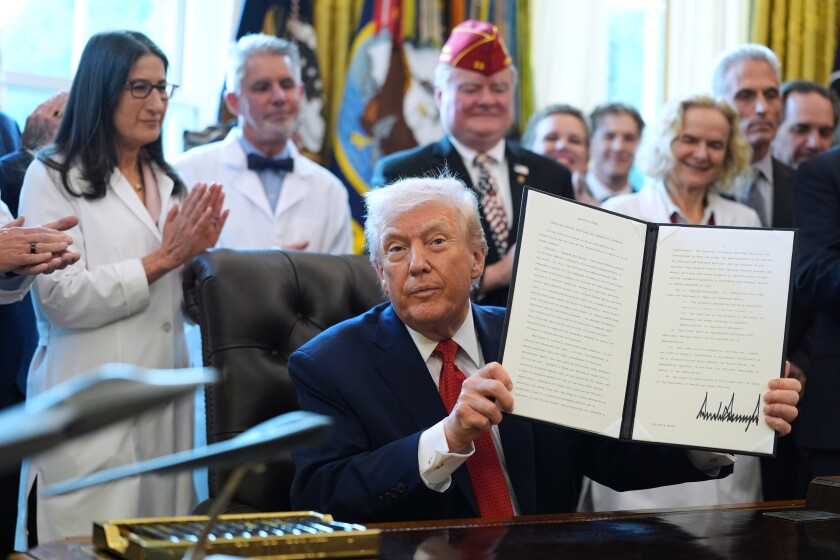
In a significant policy shift, President Donald Trump has ordered the reclassification of marijuana from Schedule I to Schedule III under the Controlled Substances Act. This change, announced recently, effectively acknowledges the potential medical benefits of marijuana while still maintaining its restrictions. Schedule I currently includes drugs deemed to have a high potential for abuse and no accepted medical use, such as heroin and LSD. In contrast, Schedule III encompasses substances that can be prescribed, like ketamine and anabolic steroids.
The move marks a pivotal moment in the ongoing debate surrounding marijuana, particularly since it comes nearly four decades after Francis Young, then chief administrative law judge at the Drug Enforcement Administration (DEA), argued against marijuana’s Schedule I classification. Young’s conclusions in 1988 suggested that marijuana was one of the “safest therapeutically active substances known to man,” citing its accepted medical use for conditions such as chemotherapy-induced nausea and multiple sclerosis spasticity. Despite his findings, the DEA maintained marijuana’s classification until this year.
According to a review by the U.S. Department of Health and Human Services (HHS), ordered by President Joe Biden, there is now “credible scientific support” for marijuana’s use in treating various conditions, including pain and nausea. HHS concluded that marijuana’s risks do not warrant its continued classification as a Schedule I substance. The report noted that most individuals use marijuana without experiencing dangerous outcomes.
The reclassification is expected to facilitate medical research by lifting some of the stringent regulations associated with Schedule I substances. Nevertheless, it does not legalize marijuana for medical use unless the Food and Drug Administration (FDA) approves specific cannabis-based products. Additionally, state-licensed marijuana businesses will remain technically illegal under federal law, although they may benefit from the new classification by being able to claim standard tax deductions, which could alleviate some financial burdens associated with high effective tax rates.
Attorney General Merrick Garland supported the reclassification in a proposed rule published in May 2024. Trump’s executive order is positioned as a measure to help “American patients suffering from extreme pain, incurable diseases, aggressive cancers, seizure disorders, neurological problems and more.” Yet, Trump emphasized that this order does not equate to legalization of marijuana, a statement that has drawn mixed reactions.
Although marijuana remains illegal at the federal level, its status has been increasingly challenged. Currently, 40 states have legalized marijuana for medical purposes, and 24 states, which represent a significant portion of the U.S. population, also allow recreational use. This presents a complex conflict between state and federal laws, particularly as public opinion increasingly favors legalization.
The implications of this reclassification extend beyond medical research. It addresses some of the challenges faced by state-legal marijuana businesses, which have operated under restrictive federal regulations. While the new classification does not legalize these businesses, it offers a pathway for some financial relief and could signal further changes in federal cannabis policy.
As the landscape of cannabis regulation continues to evolve, the recent actions by the federal government may pave the way for broader acceptance and research opportunities in the years to come.