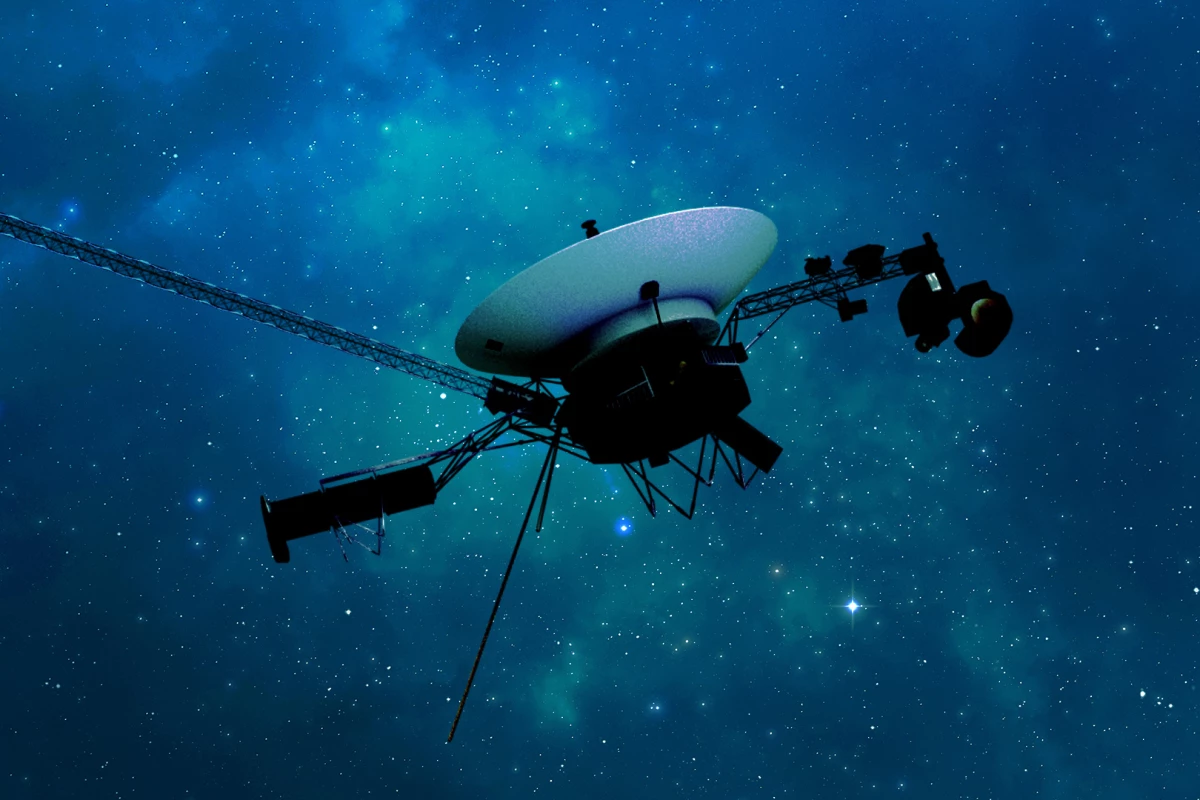
NASA’s Voyager 1 space probe, launched in 1977, is on the verge of a significant milestone as it approaches a distance from Earth where a radio signal will take 24 hours to arrive. By late November 15, 2026, Voyager 1 is expected to be approximately 16.1 billion miles (about 25.9 billion km) away. This distance marks a new frontier in space exploration, highlighting the vastness of the universe.
As Voyager 1 continues its journey into interstellar space, it will become the first spacecraft to achieve this milestone. Albert Einstein’s theory asserts that the speed of light is the ultimate speed limit in the universe, traveling at 186,000 miles per second (or 299,388 km/s). This means that as the probe moves farther away, the time it takes for signals to travel increases significantly. Currently, it takes about 23 hours, 32 minutes, and 35 seconds for messages to reach Voyager 1.
The implications of such distances are profound. Historical examples, like the delays experienced during the Apollo Moon landings, illustrate how communication latency can impact space missions. The Moon is roughly 226,000 miles (or 363,000 km) from Earth, resulting in a delay of about 1.3 seconds. For Mars, this delay can extend to approximately four minutes, while communication with Jupiter can take up to 52 minutes and with Pluto, as much as 6.8 hours.
Voyager 1’s journey is particularly remarkable given its age. Despite being nearly half a century old, the probe continues to function as it travels through the harsh environment of space, characterized by extreme cold and radiation. NASA remains committed to maintaining Voyager 1 until its nuclear power source is expected to deplete in the next year. The ongoing communication with both Voyager 1 and its sister spacecraft, Voyager 2, is facilitated by NASA’s Deep Space Network.
As Voyager 1 ventures further, the time taken for commands from Earth to be acknowledged will increase significantly. By late 2026, any instructions sent to the probe will take two days to receive a response, creating a unique scenario for mission engineers. Maintaining contact with the probe will require meticulous planning and patience, as the distance creates a slow-motion dynamic in managing the spacecraft.
In summary, Voyager 1’s impending achievement of a 24-hour signal distance represents a pivotal moment in space exploration. With its groundbreaking journey, the probe continues to expand our understanding of the universe, illustrating the vast distances involved in deep space missions. According to NASA, as of now, Voyager 1 is approximately 15.7 billion miles (or 25.3 billion km) from Earth, and its journey is a testament to human ingenuity and the relentless pursuit of knowledge.