NBC Sports successfully broadcast the 2026 Prevagen U.S. Figure Skating Championships over the weekend, an event significant for selecting the athletes representing Team USA at the upcoming 2026 Milano Cortina Olympics. The competition took place at the Enterprise Center in St. Louis, Missouri, home to the NHL’s St. Louis Blues, and featured cutting-edge audio technology designed to capture the unique sounds of figure skating.
In a bid to enhance the broadcast experience, NBC Sports employed innovative in-ice microphones supplied by Audio-Technica. The deployment of these microphones was a technical challenge, as Gary Dixon, director of broadcast business development at Audio-Technica, explained, “Isolating the skate-effect sounds poses an interesting challenge in an ice arena with lots of acoustically reflective surfaces.” The microphones were specifically designed to capture the sounds produced by skates gliding over the ice, free from interference from the venue’s public announcement system or crowd noise.
Karl Malone, senior director of audio engineering for NBC Sports and Olympics, emphasized the effectiveness of these under-ice microphones. “The beauty of under-ice mics is that they are a contact mic and not affected by the movement of air,” he noted. These microphones, developed for ice sports, convert vibrations on the ice into clear audio and are embedded 0.25 inches below the surface, providing an immersive listening experience that enhances the performances.
The microphones are housed in a water- and corrosion-resistant case and feature a flat, low-profile design that allows for minimal disruption to the ice surface. Their frequency tuning, between 50 Hz and 4 kHz, focuses specifically on capturing the sounds associated with figure skating.
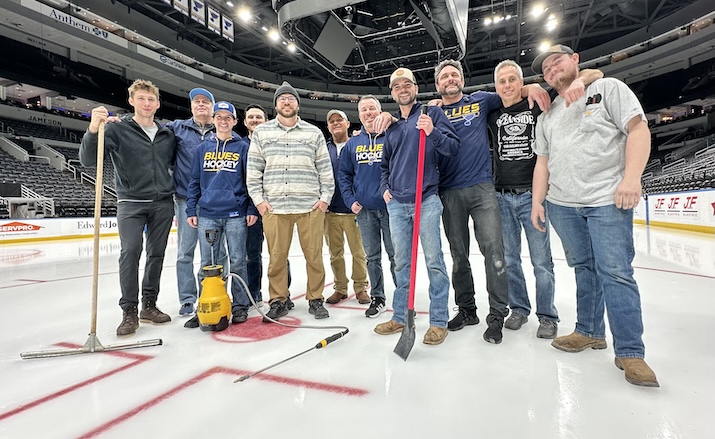
Installation of the microphones involves meticulous planning and execution. Technicians utilize woodworking routers or heated metal tools to create holes for the microphones and trenches for cabling. This process takes place on the existing ice, ensuring that the microphones are installed safely and effectively, as Dixon explained. “Figure skating actually has their own ice techs who work with the local facility’s crew,” he added, underscoring the importance of safety for the athletes.
The microphones are strategically placed six feet out from the dasher boards, with four on each side and two additional microphones positioned eight feet from the goal ends. This setup allows for a coverage area of approximately 10 feet in diameter around each microphone, capturing the dynamic sounds as skaters move across the ice.
In addition to the skating sounds, music plays a pivotal role in figure skating performances. Maintaining synchronization between the venue’s sound system and the broadcast audio requires careful coordination. Malone remarked, “We pay great attention to the music and to having that music feed direct into the broadcast mix in order to have a clean and powerful effect.” To achieve this, sound engineers must adjust for delays between direct and captured audio, ensuring a seamless experience for viewers.
As the championships concluded, the U.S. Figure Skating team for the 2026 Olympics was announced. The roster includes talented skaters such as Ilia Malinin, Amber Glenn, and pairs like Ellie Kam and Daniel O’Shea. The team now prepares to head to Milano Cortina, with Malinin emerging as a favorite for gold.
The careful planning and execution of audio technology not only improved the broadcast quality but also showcased the evolving landscape of sports media. Following the championships, the ice must be meticulously repaired for the St. Louis Blues’ next game, highlighting the intricate balance between sports and entertainment.
This event marked a significant milestone in both figure skating and sports broadcasting, setting the stage for an exciting Olympic season ahead.