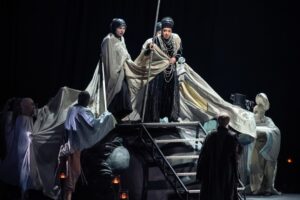
The Wiener Staatsoper has revived Richard Strauss’s powerful one-act opera, “Elektra,” for the 2025-26 season, showcasing a gripping performance that resonates with contemporary audiences. Originally composed in 1909, the opera is based on Hugo von Hofmannsthal’s libretto, which reinterprets the tragedy of Sophocles. It explores the intense psychological landscape of Elektra, fixated on avenging her father, Agamemnon’s murder at the hands of her mother, Klytämnestra, with the assistance of her lover, Aegisth.
This production marks a return to Harry Kupfer’s acclaimed 1989 staging, which continues to captivate with its stark, black set design featuring a fragmented statue of Agamemnon, symbolizing the disarray following his death. The atmosphere is enhanced by dynamic lighting that shifts subtly throughout the performance, creating an immersive experience.
Conductor Alexander Soddy set a tone of relentless tension from the outset. The Vienna State Opera Orchestra responded with a rich and luxurious sound, delivering a powerful orchestral score characterized by dense textures and dissonance. The strings shimmered, woodwinds dazzled with precision, and brass sections erupted into fierce crescendos, effectively mirroring Elektra’s emotional turmoil.
Ausrine Stundyte’s Powerful Portrayal
In the titular role, soprano Ausrine Stundyte captured the essence of Elektra’s anguish and obsession. Throughout the opera, Elektra engages in intense dialogues with her mother Klytämnestra, her sister Chrysothemis, and her brother Orest, leading to a harrowing exploration of her fractured psyche. Stundyte’s performance was marked by dramatic commitment and emotional depth, though her vocal execution at times lacked the overwhelming force expected in such a demanding role.
While her middle register showcased both beauty and strength, her higher notes occasionally faltered under pressure, contrasting with the powerful presence of her fellow cast members. Nevertheless, Stundyte’s portrayal effectively conveyed Elektra’s descent into madness.
Nina Stemme Shines as Klytämnestra
Renowned soprano Nina Stemme made a striking debut as Klytämnestra, bringing a depth of character to the role that transcended traditional villainy. Her portrayal revealed a woman deeply troubled by guilt and desperation, yearning for reconciliation with her children despite her dark past. Stemme’s entrance, adorned in opulent jewels and an elaborate cape, was a dramatic highlight, effectively establishing her character’s complex emotional landscape.
In her interactions with Elektra, Stemme skillfully navigated the dualities of vulnerability and power, showcasing her range and dramatic prowess. The dynamic between the two characters added a layer of complexity to the opera, enhancing its overall impact.
Camilla Nylund, portraying Elektra’s sister Chrysothemis, offered a compelling contrast. Rather than merely a passive observer, Nylund’s performance depicted Chrysothemis as a voice of reason, horrified by Elektra’s descent into vengeance. Her radiant soprano brought forth a delicate yet powerful expression, allowing her character’s longing for a normal life to resonate amidst the chaos surrounding them.
Derek Welton, in the role of Orest, delivered a strong performance as the avenging brother. His bass-baritone voice commanded attention, particularly during the poignant reunion with Elektra. This moment, underscored by Soddy’s sensitive conducting, encapsulated the emotional weight of the opera.
Supporting roles, including various maids and servants, were also well-executed, contributing to the overall success of the evening. Special recognition goes to Jenni Hietala, who impressed as the Fifth Maid, showcasing her impressive vocal technique and emotional clarity.
The opera concluded with a powerful finale, where the chaos of Orest’s revenge unfolds offstage, narrated by Chrysothemis and others. In a striking visual metaphor, Elektra’s ecstatic dance of death culminated in her entanglement with the ropes hanging from her father’s statue, symbolizing her inevitable demise.
Overall, the revival of “Elektra” at the Wiener Staatsoper was a resounding success, blending a timeless score with exceptional performances that brought fresh insight into Strauss’s masterwork. This production affirms the opera’s relevance, illuminating its exploration of trauma, obsession, and the destructive nature of revenge.