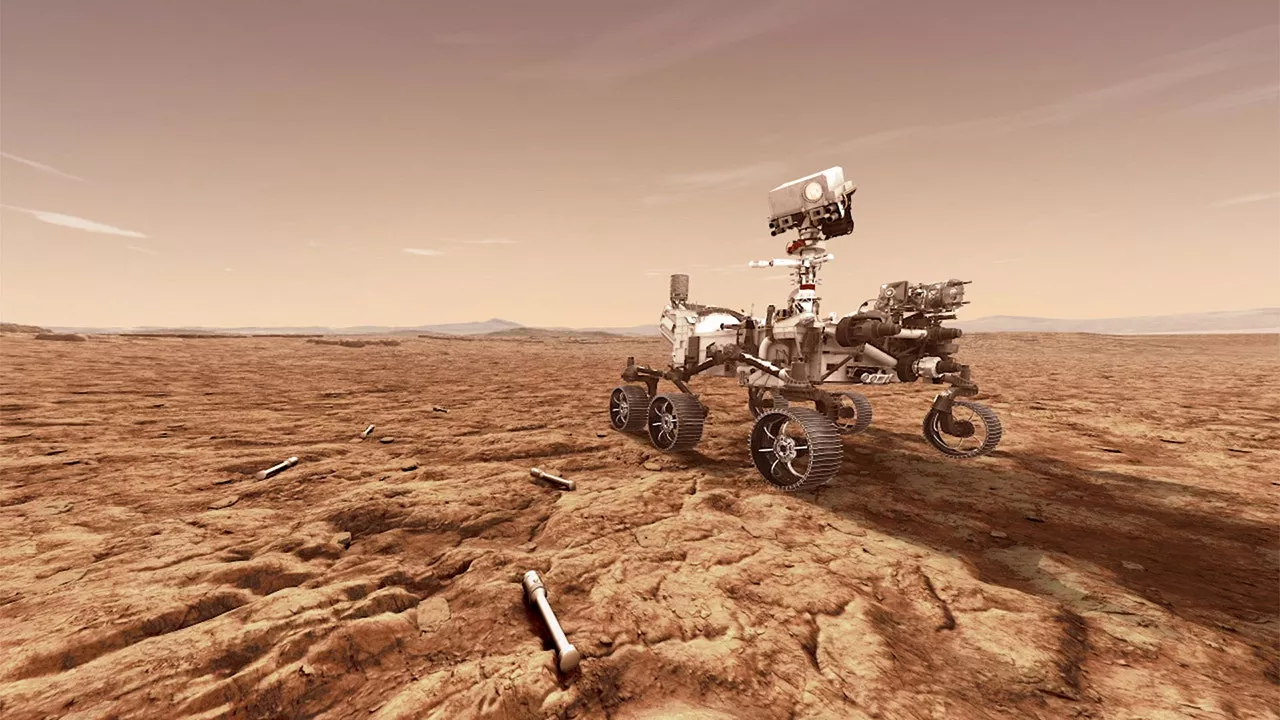
URGENT UPDATE: NASA’s Perseverance rover has potentially discovered a meteorite on Mars, a shiny rock named ‘Phippsaksla’, which shows high levels of iron and nickel. This exciting find suggests it could be a remnant from an ancient asteroid, marking a significant milestone for the rover.
The discovery, reported in a recent blog post on the rover’s mission page, was made as Perseverance navigated the rugged terrain of Jezero Crater. The unusual rock stood out amidst the landscape, prompting scientists to investigate further. Testing revealed an unusual concentration of iron and nickel, elements commonly associated with meteorites that have impacted both Mars and Earth.
This is not the first time a rover has identified a metallic rock on the Martian surface. Earlier missions, including Curiosity, Opportunity, and Spirit, have uncovered various iron-nickel meteorites. However, this find would be the first for Perseverance, which has spent nearly four years searching for signs of ancient life since landing on Mars on February 18, 2021.
To analyze the rock, Perseverance’s advanced SuperCam instrument fired a laser at Phippsaksla, vaporizing tiny bits of material to obtain readings. NASA confirmed that the results indicated a strong likelihood of a meteorite origin, as iron and nickel are typically found together only in such extraterrestrial objects, not in native Martian rocks.
NASA emphasized the significance of this discovery, noting that if confirmed, Phippsaksla would join a notable list of meteorites previously identified by earlier rovers, such as Curiosity’s finds ‘Lebanon’ and ‘Cacao’. Each meteorite discovery provides crucial insights into how these cosmic visitors interact with the Martian surface over time.
Phippsaksla’s location atop ancient impact-formed bedrock could reveal valuable information about its formation and journey to its current resting place. As NASA continues to study this intriguing rock, the agency is eager to confirm its extraterrestrial origins.
Perseverance, NASA’s most advanced rover to date, has traveled 293 million miles to reach Mars since its launch on July 30, 2020. Built at NASA’s Jet Propulsion Laboratory in Pasadena, California, the rover is equipped with seven scientific instruments and a robotic arm designed to collect samples that may one day return to Earth.
The ongoing mission is not only focused on finding signs of ancient life but also plays a vital role in preparing for potential human exploration of Mars in the 2030s. As scientists continue to analyze Phippsaksla, the excitement builds for what this discovery could reveal about our solar system’s history.
Stay tuned for more updates on this developing story, as NASA works to confirm whether Phippsaksla is indeed a meteorite, potentially redefining our understanding of Mars and its cosmic visitors.