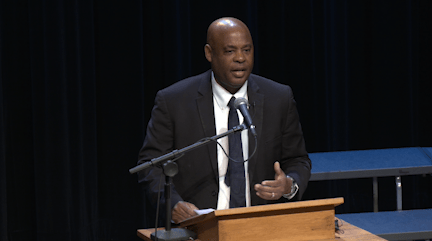
UPDATE: The Academic Senate convened just hours ago on March 2, 2023, addressing significant legislative proposals that could transform Utah’s public university system. Commissioner of Higher Education Geoffrey Landward presented two critical bills, SB240 and HB352, aimed at enhancing collaboration among institutions, a move that has sparked urgent debate among faculty members.
Landward detailed the intended impact of these bills, which focus on reducing competition between universities amid declining enrollment and financial constraints. The proposed legislation seeks to streamline student pathways and facilitate shared academic programs across campuses. This restructuring is crucial as Utah’s universities face increasing pressure to adapt to a changing educational landscape.
In his remarks, Landward emphasized that this initiative is not merely about redesigning the system but rather about maximizing existing benefits. “I see an opportunity to do even better with more focus,” he stated, advocating for a unified educational vision that promotes vertical and horizontal integration. The aim is to create a seamless transition from community colleges to research universities, ensuring that students receive the support they need for academic success.
However, the proposals have raised alarms among faculty, particularly regarding increased workloads. Dr. Harriet Hopf, former president of the Academic Senate, voiced concerns about the potential for faculty overload, noting that USHE has already increased the workload for career line faculty by up to 33%. “Could you help the legislature understand how to give us things to do that are not going to bury us forever?” she asked.
Landward acknowledged these concerns, calling them a “fair criticism” that requires careful consideration. Senator Lorie Richards inquired about the preservation of current collaborations between universities. Landward assured her that existing partnerships would be honored while encouraging new collaborations across regional campuses.
As discussions continued, several senators raised questions about the implications of eliminating redundant programs. Landward acknowledged the need for realism, stating, “Not every program can be offered so that a student never has to move away if they want a particular program.” He expressed optimism that many programs could be made available to students without requiring them to relocate.
The Academic Senate’s response to these proposals is critical as it shapes the future of higher education in Utah. With declining enrollment numbers, the urgency for a cohesive strategy is palpable. The Senate’s deliberations will have lasting implications for students and faculty alike.
NEXT STEPS: As discussions progress, stakeholders will be closely monitoring how the legislature responds to faculty concerns and the potential impacts on student access to education. The urgency of this matter cannot be overstated, as the future of Utah’s public university system hangs in the balance.
Stay tuned for updates on this developing story, as the decisions made in the coming weeks could redefine the landscape of higher education in Utah.