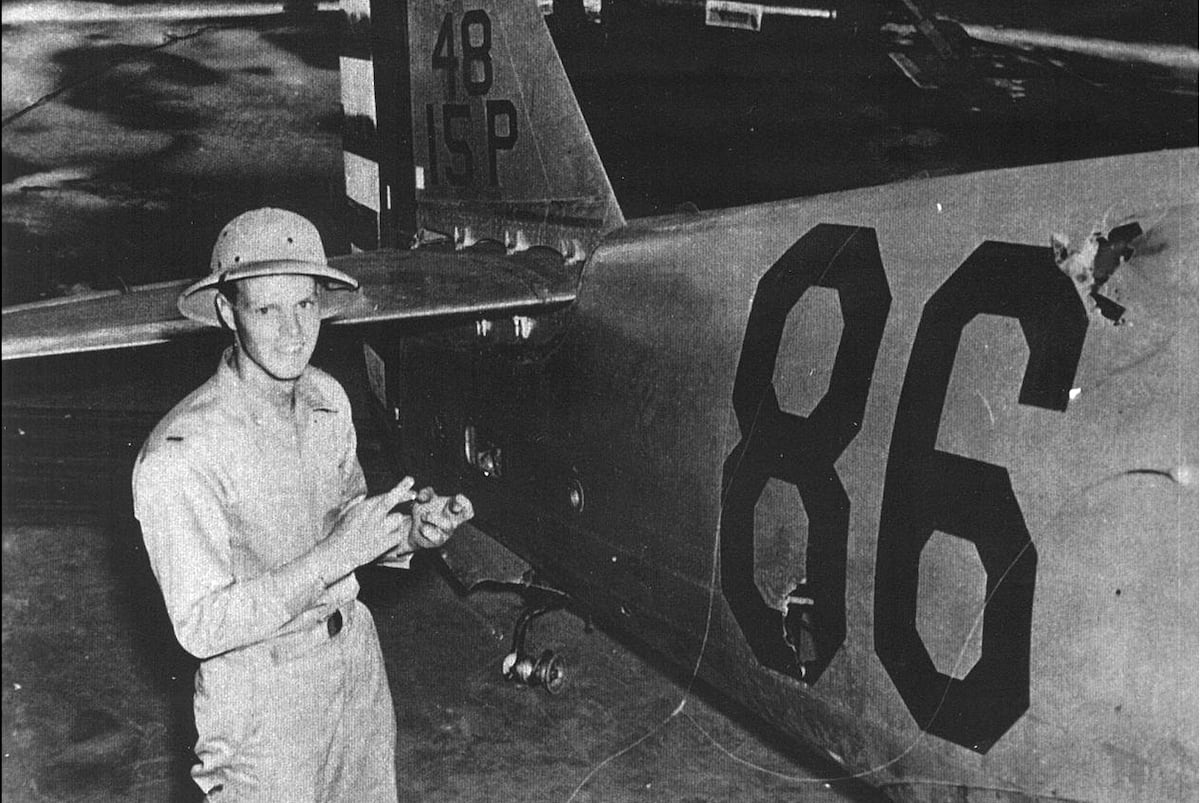
On December 7, 1941, Japanese aircraft launched a surprise attack on Pearl Harbor, marking a pivotal moment in World War II. Among the American pilots who responded was **Philip M. Rasmussen**, a 23-year-old second lieutenant in the **U.S. Army Air Corps**. Assigned to the **46th Pursuit Squadron** at **Wheeler Field** on **Oahu**, Rasmussen became one of the few pilots to take to the skies during the assault, ultimately earning a **Silver Star** for his bravery.
Rasmussen’s journey into military aviation began in September 1940, when he entered flight training. He completed his training in April 1941 and was quickly dispatched to Wheeler Field. His unit’s primary mission was to defend the islands against potential airborne threats, although an imminent conflict with Japan was not officially acknowledged. In his diary, Rasmussen noted a growing sense of foreboding. Just two days before the attack, he wrote that diplomatic relations with Japan seemed to be deteriorating.
As the sun rose on that fateful Sunday morning, Rasmussen was in his barracks when he witnessed a Japanese bomber dive towards the hangar. An object was released from the aircraft, resulting in a massive explosion. Realizing they were under attack, he dashed down the hallway in his pajamas to alert others. He quickly equipped himself with a **.45-caliber pistol** and rushed to the flight line.
Rasmussen vividly recalled the chaos that ensued. As he ran towards the aircraft, he heard bullets whistling past him. The Japanese planes were systematically targeting the American planes, which were lined up closely on the tarmac. He spotted a **Curtiss P-36**, jumped in, and started the engine just as an armorer arrived with ammunition. They loaded the aircraft and prepared for takeoff amid the continuing bombardment.
Engaging in Combat
Once airborne, Rasmussen and his squadron formed up and headed towards **Pearl Harbor**. Their mission was to intercept the attacking Japanese aircraft. As they climbed to gain altitude, they received new orders directing them towards **Kaneohe Bay**. Upon arrival, they discovered that the area was under attack.
Rasmussen engaged a Japanese aircraft, using his **.50-caliber** machine gun. His fire was effective, igniting the enemy plane, which subsequently went down in flames. As he maneuvered, another Japanese aircraft attempted to ram him. In a swift reaction, he pulled sharply to the right, but the encounter damaged his aircraft’s canopy and rudder control.
Despite the damage, Rasmussen managed to navigate through the clouds to regain control. He described the experience as instinctive, noting that their reactions were almost automatic. “Our actions were preceding our thoughts,” he reflected, explaining how they operated on instinct during the chaos of battle.
A Return to Base
After successfully evading further attacks, Rasmussen began his return to Wheeler Field. His fellow pilots had also engaged in combat, and he was briefly escorted by **Lew Sanders**, his squadron commander. Upon approaching the base, friendly forces mistook the returning aircraft for more enemy planes, but fortunately, they were not fired upon.
As he prepared to land, Rasmussen realized that his landing gear was not deployed. With the hydraulic system compromised, he pumped the emergency gear down and managed to touch down on a grassy field. The aircraft spun before coming to a stop, and he emerged dazed but uninjured.
After changing into a flying suit, Rasmussen rejoined his unit to assist in recovery efforts. The attack had caused significant damage, and many aircraft were destroyed or rendered inoperable. His actions during that day not only showcased his bravery but also highlighted the chaotic nature of aerial combat in the early stages of World War II.
Rasmussen continued to serve throughout the war, participating in numerous combat missions, including a bombing run over Japan, for which he received the **Distinguished Flying Cross**. After serving in various capacities in the Pacific, Europe, and the Middle East, he retired in 1965 with the rank of **lieutenant colonel**. He passed away in 2005 at the age of 86 and is interred at **Arlington National Cemetery**.
The narrative of Philip M. Rasmussen serves as a reminder of the courage displayed by those who defended against one of the most significant attacks in American history. His recollections from that day reveal the intensity of emotions and the rapid decisions made in the face of danger, encapsulating the valor of a generation that faced unprecedented challenges.