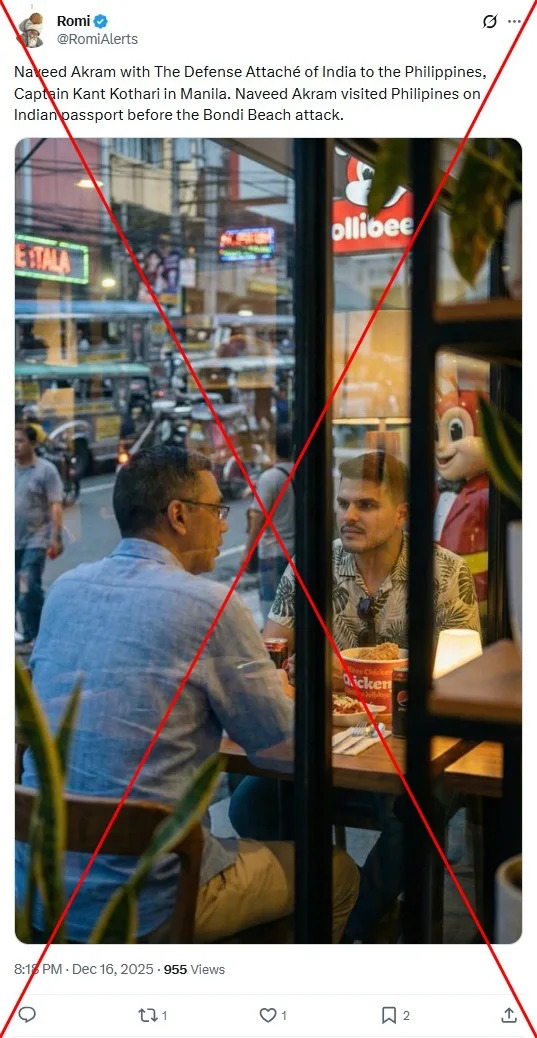
As investigations continue into the deadly shooting at Bondi Beach, Australian authorities are examining the backgrounds of the alleged gunmen, Sajid Akram and his son Naveed Akram. Recently, a misleading image circulated online, falsely claiming to show Naveed meeting with Chandra Kant Kothari, the Indian Defence Attaché to the Philippines. This image has been identified as AI-generated and labeled “fake” by India’s Ministry of External Affairs.
The controversial image appeared on social media on December 16, 2025, alongside claims that Naveed Akram visited the Philippines on an Indian passport prior to the attack. The caption suggested he was seen with Kothari in Manila, which has since been debunked. The two men purportedly appear in conversation outside a Jollibee fast-food restaurant, but this depiction is misleading.
Background of the Bondi Beach Attack
Fifteen people were killed and many others injured during a mass shooting at a Hanukkah celebration in Sydney’s Bondi Beach. Authorities have classified the incident as a terrorist attack targeting the Jewish community. Following the shooting, police began probing the shooters’ connections, leading to their travel to the Philippines prior to the attack.
According to reports, Sajid and Naveed Akram spent nearly all of November in the Philippines, with their last known location being Davao. This region has a history of Islamist insurgencies, but Philippine officials have stated there is no evidence linking the area to terrorist training activities.
Indian police confirmed that Sajid Akram is an Indian citizen who left Hyderabad in 1998 and has had limited contact with his family since then. Naveed, on the other hand, holds Australian citizenship. While the elder Akram was killed in a shootout with police, his son survived the confrontation.
Debunking the Misinformation
The Indian Ministry of External Affairs responded to the circulating image on December 17, 2025, emphasizing the need for vigilance against disinformation on social media. The ministry’s post stated, “Always stay alert against disinformation and fake posts on social media,” explicitly refuting claims regarding Indian diplomats meeting the accused in the Philippines.
Investigation into the authenticity of the image revealed that a reverse image search confirmed it was created using Google’s AI tools. The image was marked as “Made with Google AI” in the platform’s metadata. Further analysis with Google’s SynthID tool, which detects AI-generated content, indicated a “Very High” confidence that the image was artificially created.
Visual errors in the image, such as distorted text on the Jollibee bucket and inconsistencies in the sizes of vehicles in the background, further corroborate its AI-generated nature. Previous efforts by the Australian Associated Press and India’s The Quint have debunked similar misinformation related to the Bondi Beach shooting.
As the investigation unfolds, authorities continue to address the spread of false information while focusing on the tragic events that unfolded at Bondi Beach. The situation underscores the critical need for accurate reporting and vigilance against misleading claims in the wake of such significant incidents.