Tensions in the Korean Peninsula are escalating as North and South Korea intensify their efforts to develop nuclear-powered submarines. This surge in military capabilities comes in response to evolving security strategies from the United States, which have prompted both nations to enhance their maritime defenses.
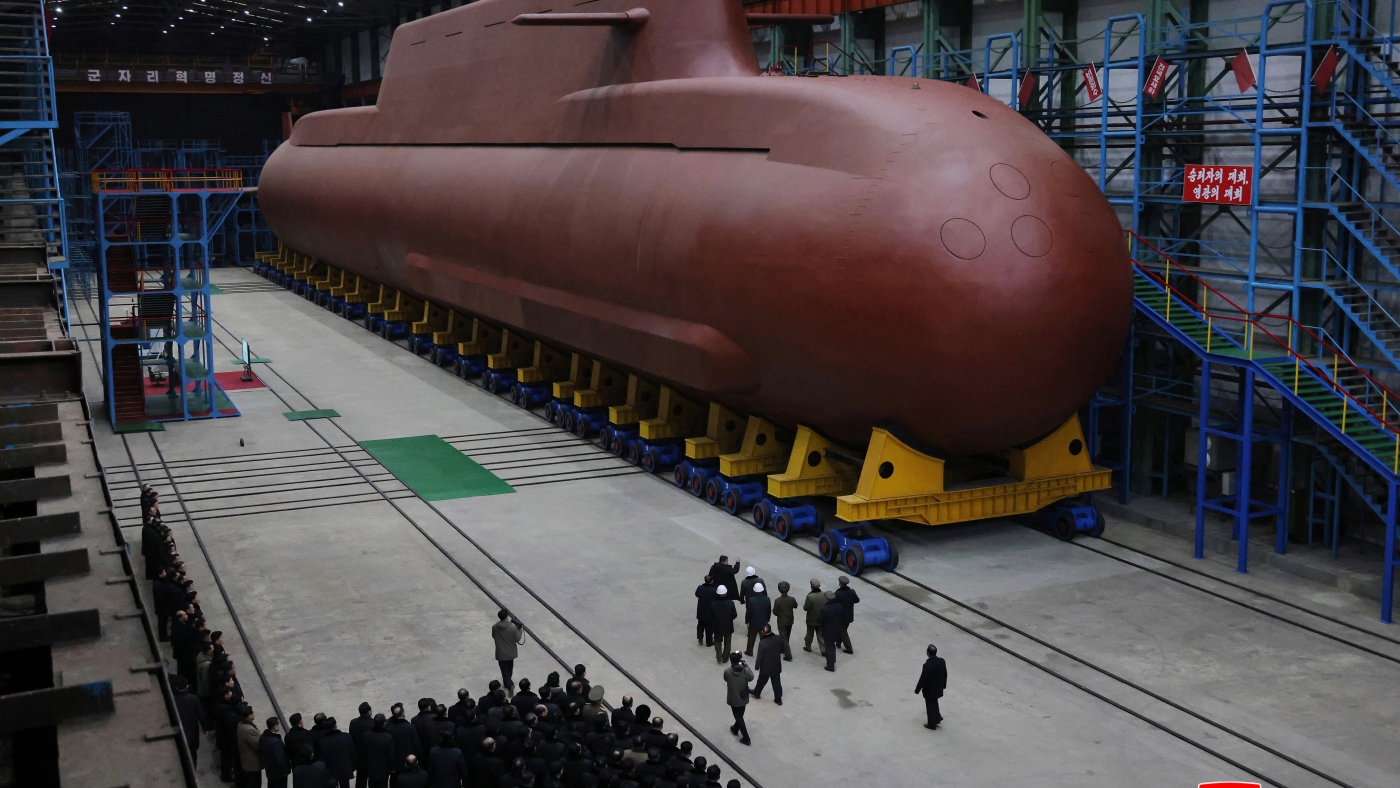
On October 26, 2023, North Korea’s state media showcased an image of what it identified as an “8,700-ton nuclear-powered strategic guided missile submarine.” This marks the first official announcement regarding the submarine’s tonnage and hull completion since North Korea committed to pursuing nuclear submarines in 2021. North Korean leader Kim Jong Un emphasized the necessity of this vessel for national defense, citing an increasingly challenging security landscape. He criticized South Korea’s plans to develop its own nuclear submarines as “an offensive act” that must be countered.
In response, South Korea has accelerated its submarine development program following a green light from the United States in October 2023. The South Korean government has established a pan-government task force aimed at facilitating this initiative. Additionally, national security adviser Wi Sung-lac indicated that South Korea is working on an agreement with the U.S. to secure military-grade nuclear fuel.
Strategic Implications for Regional Security
The drive for nuclear-powered submarines is not merely a reaction to North Korea’s actions; it also aligns with broader U.S. defense objectives. Admiral Daryl Caudle, the chief of naval operations for the U.S. Navy, stated during his visit to Seoul that South Korean submarines are expected to play a vital role in addressing not only North Korean threats but also challenges posed by China’s expanding military presence in the region.
President Lee Jae Myung acknowledged this strategic expectation, mentioning China’s influence during discussions with U.S. officials. He highlighted the limitations of South Korea’s conventional diesel submarines, which struggle to operate effectively in the shallow waters around the peninsula. Retired South Korean navy captain Yoon Sukjoon noted that expanding operations into deeper waters could enhance South Korea’s deterrent capabilities against both North Korea and China.
While South Korea is cautious about overt military confrontation with China—its largest trading partner—public sentiment reflects an increasing desire for enhanced military capabilities. A recent survey indicated that many South Koreans favor the development of nuclear armament, even if it risks international sanctions or the withdrawal of U.S. troops.
Concerns About U.S. Commitment
Experts express concerns that the shifting U.S. focus on regional security may lead to a diminished perception of American commitment among its allies. According to a poll conducted by the Asan Institute, less than half of South Koreans believe the U.S. would respond with nuclear force if North Korea were to launch an attack. This uncertainty drives public support for an independent nuclear deterrent.
Political scientist Kim Heungkyu, director of the China Policy Institute at Ajou University, suggests that South Korea, alongside Japan, is increasingly wary of falling under China’s influence. He argues that the absence of a robust U.S. presence in the Western Pacific necessitates a strategic pivot towards nuclear capabilities for South Korea’s survival.
Although the South Korean government maintains that it does not seek to develop nuclear weapons, ongoing discussions regarding uranium enrichment and spent fuel reprocessing with the U.S. have raised eyebrows. Kim argues that the current trajectory, influenced by U.S. policies, could inadvertently push South Korea and Japan towards nuclear armament.
As the arms race between North and South Korea intensifies, the implications for regional stability and international relations remain significant. The development of nuclear submarines could alter the balance of power in the Indo-Pacific, prompting further military and diplomatic responses from both regional powers and the United States.