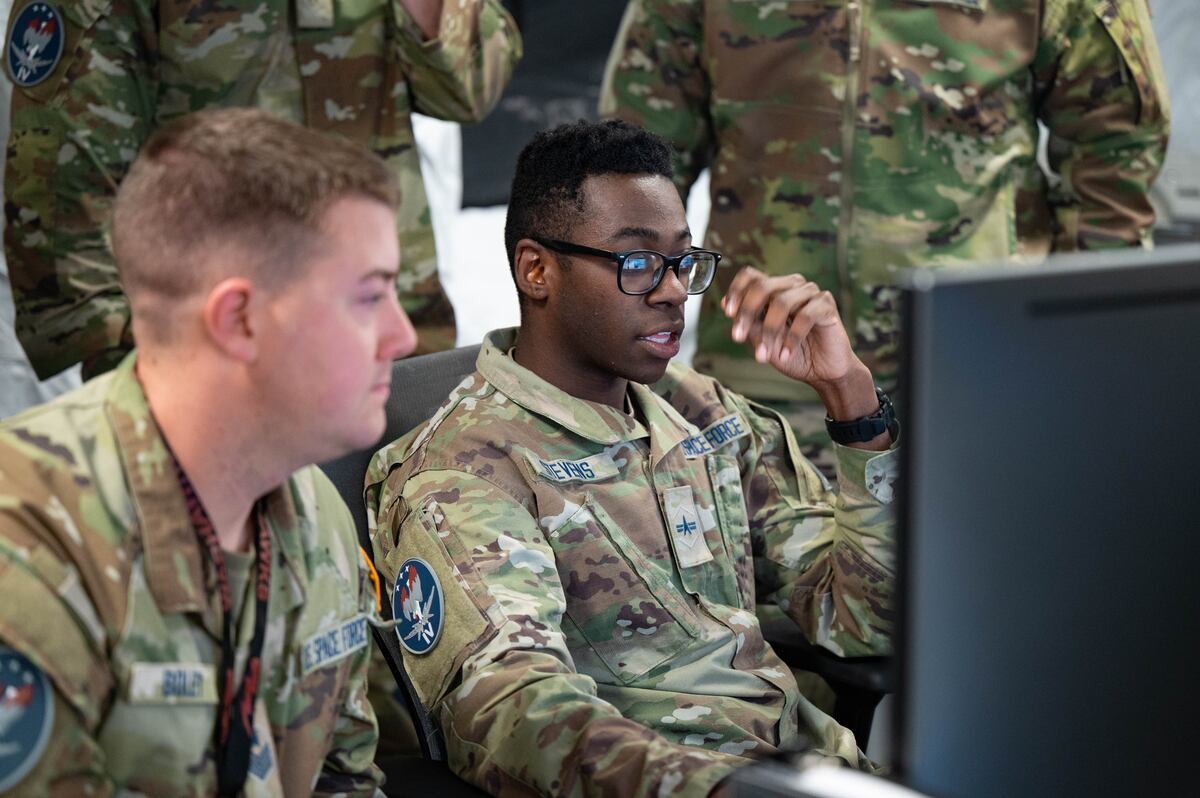
The U.S. Space Force is advancing its capabilities through the Space Warfighter Operational Readiness Domain, known as SWORD, which is set to be a pivotal element in maintaining space superiority. During a media roundtable at the Space Industry Days in Los Angeles, California, Colonel Corey Klopstein, program executive officer for Operational Test and Training Infrastructure and commander of System Delta 81, emphasized the program’s emphasis on realism and operational readiness.
SWORD functions as the Space Force’s primary synthetic training environment, utilizing a cloud-enabled digital simulation platform. This innovative tool replicates contested space operations, incorporating elements like orbital dynamics, electronic warfare, and cyber effects. By providing realistic training scenarios, SWORD enables guardians to prepare without being solely dependent on live, on-orbit assets or centralized training facilities.
In large-scale exercises such as Space Flag, SWORD has already demonstrated its effectiveness, supporting hundreds of guardians with realistic training scenarios. Klopstein noted that the platform is being scaled for broader enterprise use, reinforcing the importance of adaptability and realism in training.
“Our intent is to develop SWORD and make it as realistic as possible,” Klopstein stated. He highlighted the continuous collaboration with users to identify their needs and enhance the fidelity of the training environment. This realism is achieved through rigorous validation processes, where digital models in SWORD are regularly updated by cross-checking them against hardware-in-the-loop facilities and actual on-orbit assets.
“It’s a constant back and forth in trying to increase the fidelity of your digital environment,” Klopstein explained. He stressed that the Space Force cannot rely solely on synthetic data for effective training.
Speed is another critical component of SWORD. With adversary tactics evolving at a rapid pace, the Operational Test and Training Infrastructure is focused on the quick integration of new threats into the simulation platform. Klopstein mentioned the close coordination with intelligence units and the National Space Intelligence Center to ensure timely updates to threat emulations.
“We’re working closely with our S2 and the Field COM S2s, as well as NSIC, to get the latest information that we can and leverage that information to provide updates to any red threat emulations within SWORD,” he said. This approach aims to ensure the highest level of accuracy in training scenarios.
Looking ahead, SWORD is set to transition to a cloud-based infrastructure, allowing guardians to conduct realistic training from their home stations rather than relying solely on centralized facilities. Klopstein referred to this vision as creating “backyard ranges,” enabling guardians to utilize the synthetic environment as their training reference.
Current implementations of SWORD are site-specific, but the long-term plan encompasses enterprise-wide access. Klopstein outlined this strategy alongside the program’s support through agile acquisition cycles lasting 10 to 12 months, aimed at closing immediate training gaps. A cloud pathfinder is also planned for fiscal 2027, as reported by Air & Space Forces Magazine and Breaking Defense.
The advancements in the SWORD program highlight a significant commitment by the U.S. Space Force to enhance its operational capabilities and ensure readiness in an increasingly contested space environment.