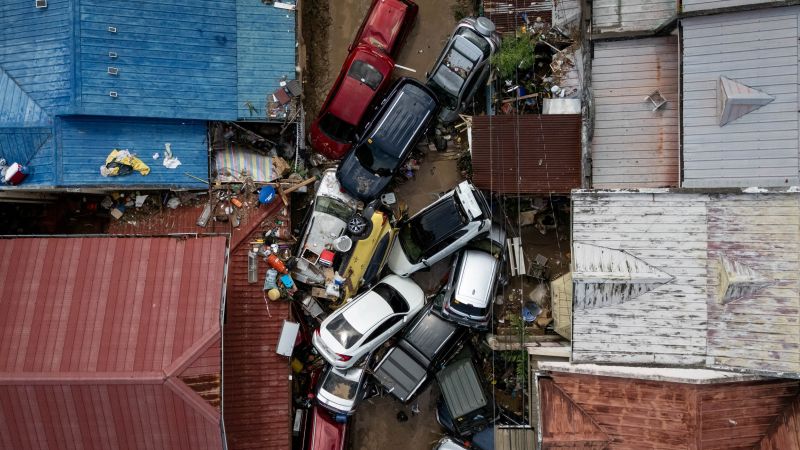
Typhoon Kalmaegi has wrought havoc across the central Philippines, becoming the deadliest storm in the country this year. The typhoon struck earlier this week, resulting in at least 114 fatalities and leaving many individuals unaccounted for, primarily in Cebu province. This region, renowned for its tourism, now faces the daunting task of recovery as residents sift through debris and mud following extensive flooding.
As floodwaters recede, the damage is becoming clearer. Entire neighborhoods have been decimated, with drone footage revealing streets transformed into rivers and homes rendered uninhabitable. In Talisay City, many houses have collapsed, and communities along the Mananga River are buried under mud. Residents like Mely Saberon, 52, expressed their despair, stating, “We don’t have any home anymore. We weren’t able to salvage anything from our house.” Another survivor, Marlon Enriquez, 58, described the rapid onset of flooding, a phenomenon he had never experienced in his 16 years living in Cebu City.
The Philippine government, led by President Ferdinand Marcos Jr., has declared a state of national calamity to facilitate ongoing relief efforts and recovery operations. The typhoon’s impact follows closely behind a powerful 6.9 magnitude earthquake that struck Cebu in September, resulting in 74 deaths and further displacements.
Why Was Kalmaegi So Destructive?
While the Philippines frequently faces typhoons, Kalmaegi made landfall as a Category 2 storm but exhibited a slow movement that exacerbated its impact. It was the 20th named storm to affect the country in 2023, yet its prolonged rainfall led to flash floods that overwhelmed communities. Reports indicate that rainfall levels reached between 150 and 250 mm (6 to 10 inches) within just 24 hours in nearby Leyte and northern Mindanao, significantly exceeding typical monthly averages for November.
Meteorologists emphasize that while wind speed often captures public attention, water is the leading cause of fatalities during such storms. The torrential rains overwhelmed drainage systems, particularly in Cebu, where inadequate infrastructure failed to manage the influx. Bernardo Rafaelito Alejandro IV, deputy administrator of the Philippines Office of Civil Defense, stated the need for better early warning systems and resilient infrastructure to mitigate future disasters.
The Philippines has suffered not only from natural disasters but also from a significant corruption scandal involving flood control projects. Allegations have surfaced against numerous legislators and construction firms accused of misappropriating funds intended for flood prevention, prompting public outrage and protests.
What Lies Ahead for Kalmaegi?
As Typhoon Kalmaegi continues to move over the South China Sea, it has intensified, reaching wind speeds of 215 kph (130 mph) and is expected to make landfall in central Vietnam on Thursday night. Areas such as Danang, Quang Ngai, and Dak Lak are bracing for damaging winds, heavy rainfall, and potential storm surges. Authorities anticipate evacuating approximately 350,000 residents in Gia Lai province to ensure their safety.
Vietnam is still recovering from severe flooding that occurred the previous week, which left at least 13 people dead and inundated over 116,000 homes. Historical sites, including the UNESCO World Heritage town of Hoi An, were also submerged, highlighting the region’s vulnerability.
The ongoing climate crisis is contributing to the intensity of storms in the western Pacific. Rising ocean temperatures, attributed to human activity, are fueling larger storms and increased rainfall. As regions like Vietnam prepare for the impending impact of Typhoon Kalmaegi, the need for robust disaster response and resilient infrastructure is becoming increasingly vital.
The devastation caused by Typhoon Kalmaegi serves as a stark reminder of the challenges posed by natural disasters and the pressing need for effective governance and infrastructure development in vulnerable regions.