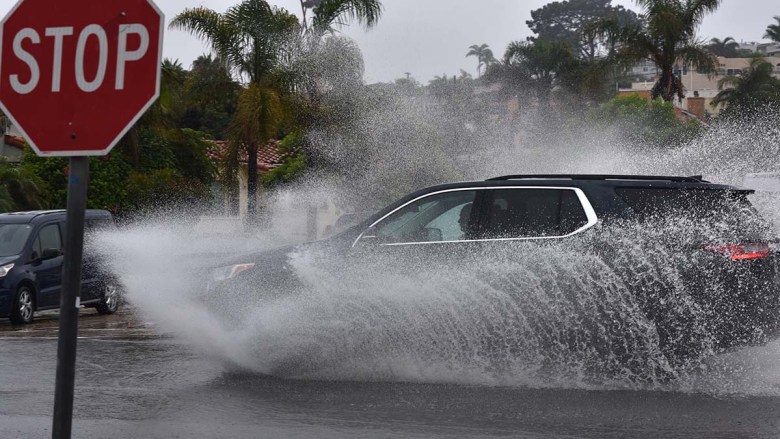
San Diego County is currently experiencing its third and final storm system of the week, bringing heavy rain and gusty winds that are expected to taper off by Friday morning. According to the National Weather Service (NWS), the primary concern remains strong and potentially damaging winds, particularly in mountainous regions and adjacent desert slopes. A wind advisory will stay in place until at least 2 a.m. on March 15, 2024.
The NWS warns that “the combination of wind and heavy snow will make driving Thursday afternoon and evening in the mountains an unsafe adventure better left undone.” Coastal areas and western valleys may also experience a slight chance of thunderstorms as the storm passes through. Localized flooding is a possibility due to heavy rainfall, with an additional 3 to 8 inches of snow forecasted for the county’s mountains overnight.
Precipitation levels leading up to the storm have already varied significantly across the county. For instance, during a 72-hour period ending at 10 a.m. on March 13, 2024, the NWS reported precipitation totals including 5.89 inches at Lake Cuyamaca, 4.78 inches in Julian, and 4.66 inches in Pine Hills. Other notable totals included 4.03 inches at Henshaw Dam and 3.93 inches on both Birch Hill and Volcan Mountain.
The effects of the storm are being felt beyond rainfall. Winds have reached remarkable speeds, with gusts recorded at 76 mph in the mountains, 80 mph in inland valleys, and winds of 52 mph in the desert. Coastal areas also faced strong winds, peaking at 49 mph near Oceanside Municipal Airport.
As the storm system concludes, warmer and drier weather is anticipated from Friday through Monday, with temperatures expected to rise approximately five degrees above seasonal averages. The NWS has indicated that the return of rain initially predicted for mid-week is now less certain.
Residents are advised to remain cautious as they navigate the impacts of this storm system, particularly in areas prone to flooding and hazardous driving conditions. The ongoing weather events serve as a reminder of the unpredictable nature of winter storms in the region.